
Unpacking Recent "Plant-Based" Packaging News
Plants are thriving in the news
Plants inspire joy for real reasons. Our food grows from them. They clean the air we breathe. They are major contributors to a stable climate. Receiving a package labeled “plant-based” carries all that goodwill, and that's exciting.

But not every plant is the same, and not every package ends up in the same place.
Take for instance a recent report from the Associated Press about CJ Biomaterials, a global leader in the manufacturing of plant-based bioplastics, also known as PHAs. CJ Biomaterials is using PHAs—polymers made by feeding sugar to microorganisms, then pelletized and molded like conventional resin—as a sustainable alternative to microplastics. CJ Biomaterials says bacteria will consume its PHA in a compost pile within six months.
This is a nice step in the right direction but there are often still roadblocks. Most places in the US lack infrastructure to support a product that looks and feels like plastic. Yes, it is compostable but the burden is on the consumer to understand which bin to throw it in and it’s often treated like plastic after it goes in.
Also in the same month, Kimberly-Clark announced a program built around hesperaloe, a low-water succulent native to the American Southwest, with a pilot facility in Yuma, AZ. Their chief R&D officer called it a moonshot with the potential to reshape the hygiene category.
This plant-based product has different considerations. We all know where the toilet paper ends up but understanding what it is made from is another question entirely and a fascinating use of plants.
Both are worth reading in full. Neither is a Kanbol story, and we have no commercial relationship with either company.
Our love for all plants aside, two questions decide almost everything:
What is the plant grown for?
What happens to the packaging after it's been used?
A container can be made entirely from plants, be entirely compostable in a laboratory, and still end up in a landfill because no facility within a trucking distance will take it.
Growing plants for packaging
Packaging feedstocks fall into three categories: fossil, purpose-grown, and residue.
For plant-based materials, the distinction that matters is whether the plant was grown for the packaging or grown for something else entirely.
Fossil — petroleum and natural gas. The default. Mining fossil carbon that is hundreds of millions of years old to create a product that will last for centuries.
Purpose-grown — corn kernels, sugarcane, cassava. Genuinely renewable, and a real improvement on fossil carbon. But the land, water, and fertilizer belong to the packaging, because the crop was planted to make it. This is where PLA bioplastics sit, and the sugar-fed PHAs covered in the AP article.
Residue — corn stover, wheat straw, bagasse. The plant was already grown, already irrigated, already fertilized, for food, feed, or fuel. Using the residue adds no acreage, irrigation, or fertilizer to the ledger.
A corn-kernel bioplastic and a corn-stover container are both, technically, "made from corn." The first requires that a dedicated field be planted. The second uses the leftovers of a field planted for other purposes.
Kimberly-Clark's hesperaloe program sits between the second and third categories: purpose-grown, but on arid land. Their stated reason isn't emissions; it's reducing dependence on forest fiber and strengthening supply resiliency.
The irony of plastic
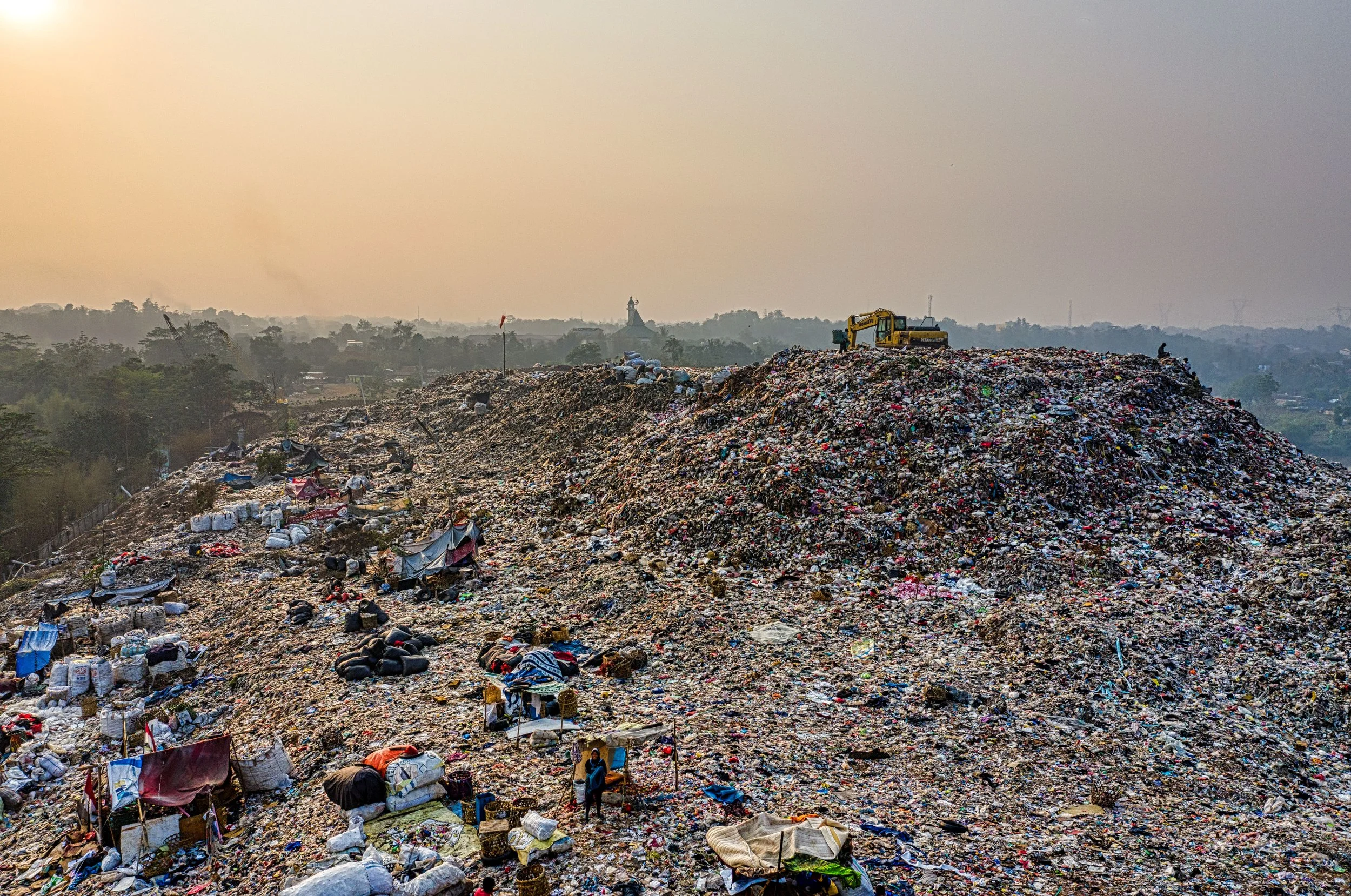
Leo Baekeland produced the first fully synthetic plastic in 1907, and what followed was a genuine achievement of industrial chemistry: materials that were cheap, light, moldable into any shape, chemically inert, waterproof and—the property everyone wanted—extraordinarily durable.
Durability was the selling point. A material that did not rot, rust, corrode, or degrade solved real problems in food safety, medicine, and transport. For example, we have plastic to thank for affordable sterile syringes.
The turn came when the permanent material that is plastic was pointed at temporary uses. In August 1955, Life magazine ran a photograph of a family cheerfully throwing disposable items into the air, under the headline "Throwaway Living." Single-use was presented—accurately, for the time—as liberation from washing up.
Plastic did not fail us. We asked for a material that lasts forever, and we got one. It is still keeping that promise: in our oceans, in our air, in our food, and in human tissue.
What the label is actually telling you
You often see the following four phrases on packaging. They are not synonyms, and only one of them explains where the packaging ends up at the end of its life (end-of-life).
Plant-based. Meaning the feedstock contains plants, but not only plants. Sets no minimum percentage and names no standard. It tells you nothing about end-of-life and does share the menu of plants in the “plant-based” claim.
100% from plants. This only tells you about what it was created from and still does not cover if the plant was grown for the purpose of packaging or if it was a resin given a second life as packaging. It also leaves out how the material is treated at end-of-life. PLA is 100% from plants and behaves exactly like plastic at the sorting line.
Bio-based. Meaning that the feedstock contains a percentage of carbon from renewable sources. The share can be modest, and the label still applies. It tells you nothing about end-of-life.
Compostable. The only label that refers to end of life. Two requirements: a standard used to test and confirm its compostability, and it’s often still up to the consumer to uncover if a nearby facility will accept it.
Three of these four describe how a product is created. Only one describes how it will break down, and that one is conditional on infrastructure most of the country does not have.
The problem with where it ends up
A bioplastic is still a plastic. PLA and PHA are polymers; the difference lies in where the carbon originated, not how the material behaves in a sorting facility.
So, a compostable cup that looks like a conventional cup gets treated like one. It is sorted into the plastics stream, where it contaminates the bale. Or it is thrown into the compost bin at a facility that does not accept resins, where it contaminates the compost. A well-intentioned product becomes somebody's rejection problem. The Associated Press recorded exactly this in its own reporting.
Composting infrastructure is still scattered across the US. Many quick-serve restaurants use compostable packaging but cannot compost it at their own locations.
We hear this from customers constantly—the desire for access to composting, but also confusion about what consumers put in which bin. We get it. Recycling, composting, and trash are genuinely complicated, and there are entire organizations dedicated to untangling it.
We sometimes hear: "I don't want to greenwash and use compostable when I'm not composting." To that, we ask customers to consider the feedstock. Yes, it is difficult for a compostable product buried in an anaerobic landfill to break down. But we would rather have a bowl made from cornstalks leaching into soil than one shedding microplastics downstream in a water supply.
Composting infrastructure isn't perfect. Compostable products are still a step in the right direction.
Our feedstock: corn stover
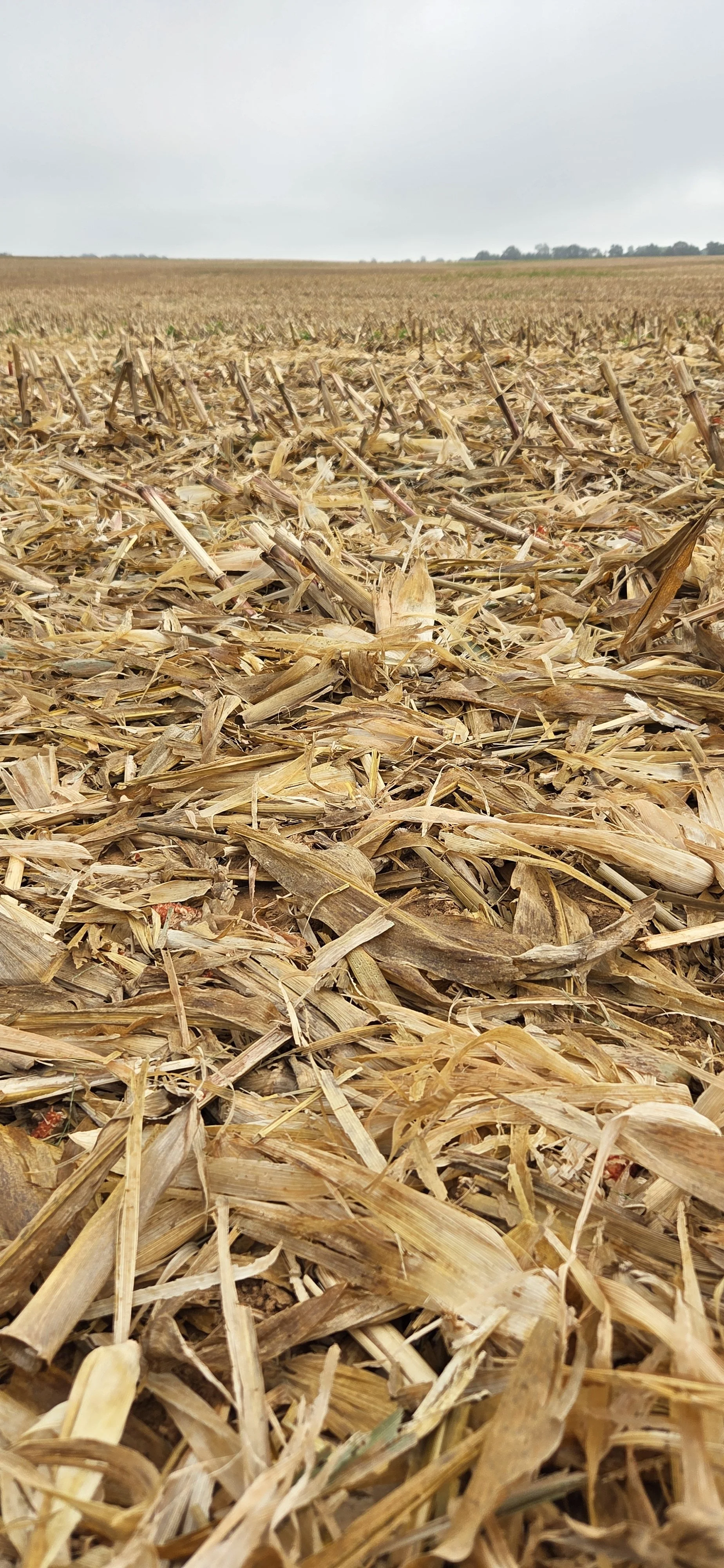
Our feedstock falls in the residue category. We use the stalk, leaf, husk, and cob left standing after the combine has passed through and taken the grain. We don't grow corn. We take about half of what's left in a field.
100% of crop residue isn't wasted in an agronomic sense. Left on the field, it protects against erosion, feeds soil organic matter, and holds moisture. But thanks to improvements in corn yields and the rise of regenerative and no-till farming, there is excess stover on the field. There is an appetite from farmers to remove and receive compensation for what would otherwise require time and resources to remove.
Published work from the University of Nebraska and USDA's National Laboratory for Agriculture and the Environment puts sustainable removal at roughly two tons per acre for continuous corn under conservation tillage—about half of what a field in Kentucky yields. We've worked with experts and our farmers to refine our harvesting technique and monitor yields in subsequent crops.
Removing stover also removes nutrients from the soil: nitrogen, phosphorus, and potassium. We compensate our farmers monetarily for that loss. Farming is a volatile business, and an additional revenue stream is worth something to the growers we work with.
What to ask before you buy
Two questions settle most of this. Is it fiber or a resin? And will a facility near your operation actually take it? The first one is often easier to find; just ask your supplier.
For the second, we believe composters are heroes of the community and love to partner when we can. If you are specifying foodservice packaging and want a straight answer about what happens afterward, including whether it will work where you operate, we are glad to have that conversation and are always open to working with your local composter to see what we can do to ensure our loop closes on a field, not in a landfill.
kanbolinc.com · impact@kanbolinc.com
Sources: USDA NASS 2026 Acreage; USDA NASS Kentucky; Iowa State Extension; University of Nebraska and USDA NLAE; Associated Press, 11 August 2026; Holland & Knight EPR survey; CalRecycle AB 1201 determination, June 2025.